

European businesses often see the same reporting mismatch. Google Search Console shows more clicks, yet GA4 sessions and conversions do not rise at the same rate. The difference may come from consent refusal, browser restrictions, tag errors, regional rules, or a dashboard that treats partial analytics data as the complete truth.
EU SEO and GDPR need to be planned together because privacy choices affect what can be measured after someone reaches a website. They do not stop SEO from working, but they influence attribution, conversion analysis, dashboards, and forecasting. This guide explains which data sources to trust, how consent changes reporting, what to test, and how to measure organic search in Europe without hiding the gaps.
This is operational guidance, not legal advice. Cookie and analytics requirements can vary by country, purpose, configuration, and data flow. Verify national guidance and current platform documentation before implementation.
What EU SEO and GDPR change
GDPR does not prevent a business from publishing content, earning links, improving technical SEO, or ranking in Google. Crawling and indexing still depend on whether search engines can access and understand public pages. The measurement challenge begins when a site stores or accesses information on a visitor’s device, creates identifiers, connects sessions, or sends data to analytics and advertising platforms.
Organic search in Europe has two connected measurement environments.
The first is search result performance. Google Search Console reports clicks, impressions, click through rate, average position, queries, pages, countries, and devices. Its data has limitations. Some queries are anonymised, some table data is truncated, and metrics can be aggregated differently at property and page level. Google’s Search Console performance documentation explains how the report counts and groups data.
The second is onsite behaviour. GA4 or another analytics platform may record landing pages, engagement, events, conversions, and revenue. This layer can be affected by consent choices and tag behaviour. A person can click from Google, appear in Search Console, reject analytics consent, and never appear as a normally tracked GA4 session.
A sound EU SEO and GDPR report does not force Search Console clicks and GA4 sessions to match. The tools measure different stages, use different definitions, and may include different visitor populations.

Privacy compliance and search performance
A consent banner is not a direct ranking factor, but a poor implementation can cover content, shift layouts, delay rendering, or load unnecessary scripts. Give users a clear choice, block optional tags correctly, and keep essential content accessible and fast.
The legal layers behind analytics
Many guides describe website tracking as a GDPR issue only. In practice, European measurement commonly involves both GDPR and national laws implementing ePrivacy rules.
GDPR governs personal data processing. It requires a lawful basis, transparency, purpose limitation, data minimisation, security, and accountability. The official GDPR text on EUR Lex sets out these principles and lawful bases.
Cookie and similar technology rules address storing information on, or accessing information from, a user’s device. The European Commission’s online privacy guidance identifies analytics and market research cookies among technologies that may require clear information and consent.
Valid consent must be a real choice
Where consent is required, it should be freely given, specific, informed, unambiguous, and expressed through a positive action. Users must also be able to withdraw it. The European Data Protection Board’s consent guidelines and the European Commission’s valid consent guidance provide the main standards.
Preselected analytics categories, implied consent, hidden refusal controls, or tags that fire before the user acts can create legal and trust problems. The EDPB cookie banner taskforce report examines recurring design and implementation issues across European complaints.
Country guidance can differ
There is no safe assumption that one analytics setup works in every European market. France’s CNIL allows a narrow exemption for certain audience measurement tools when strict conditions are met. Ireland’s Data Protection Commission states that consent is required for analytics cookies.
A first party tool limited to anonymous audience statistics may require a different assessment from GA4 connected to advertising, audiences, and identifiers. Before choosing an approach, document the countries served, technologies used, and how data is shared, retained, and transferred.

A reliable SEO measurement architecture
The strongest reporting setup does not depend on one platform. It combines several sources and gives each one a defined role.
Google Search Console for search visibility
Search Console should be the foundation for Google visibility reporting. Track clicks, impressions, click through rate, landing pages, queries, countries, devices, and search appearance.
Separate branded and non branded demand where the data supports it. Non branded growth is usually more useful for judging whether SEO is reaching new searchers.
Search Console omits some queries for privacy, limits displayed rows, and mainly credits canonical URLs. Focus more on trends in clicks and impressions than on average position alone.
GA4 for measured onsite behaviour
GA4 can explain what tracked visitors do after arrival. It can connect organic landing pages to form submissions, purchases, content engagement, and revenue. For EU SEO and GDPR reporting, it should be described as measured behaviour, not the full organic audience.
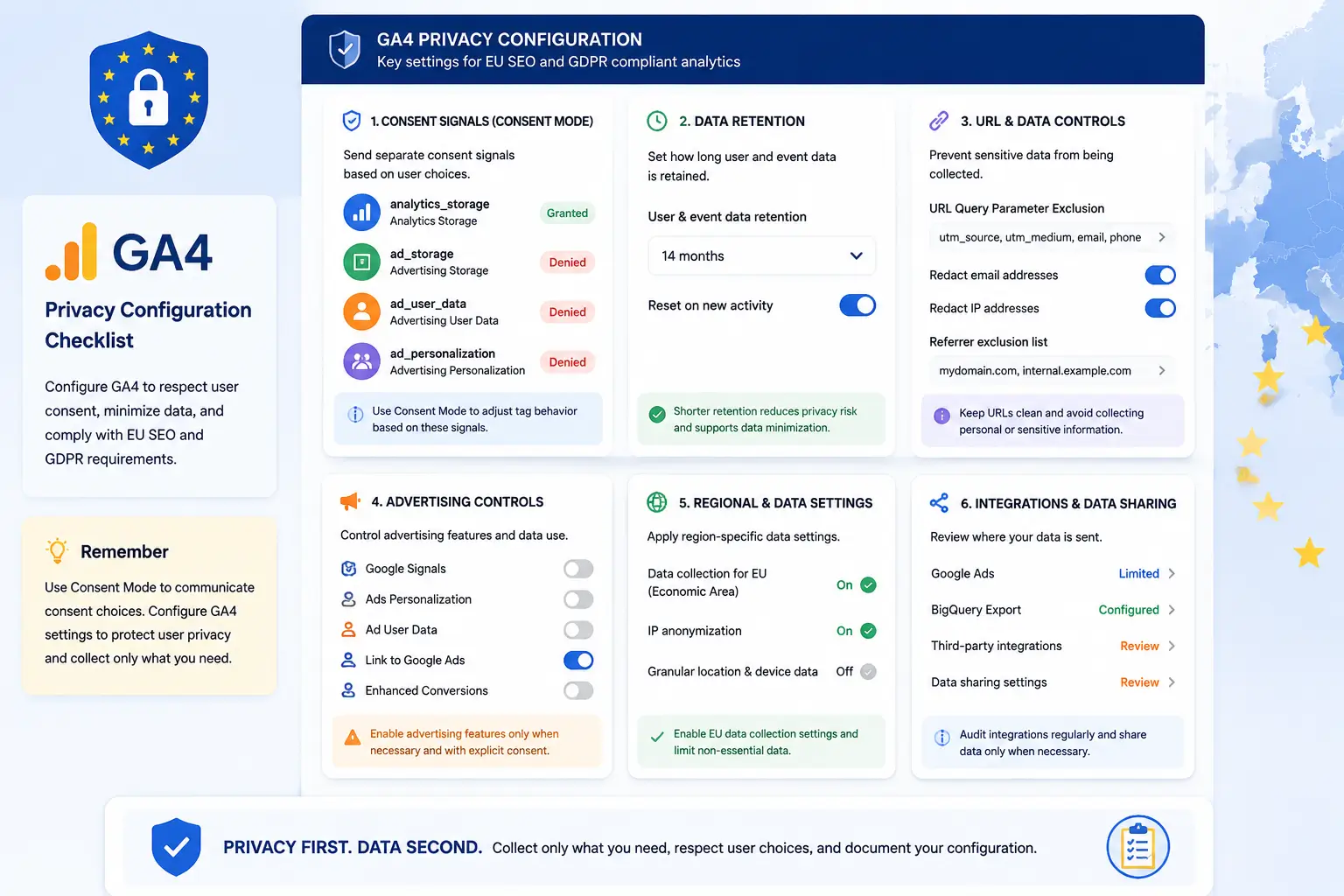
Google Consent Mode communicates consent states to Google tags. Basic consent mode blocks Google tags until consent is granted. Advanced consent mode loads tags with denied defaults and may send cookieless signals when consent is denied. Consent Mode does not create a banner or decide what is lawful. It changes tag behaviour according to signals from the site’s consent system. Review Google’s consent mode overview with legal and technical advisers.
CRM and commerce systems for confirmed outcomes
Website events are not always business outcomes. Use the CRM to confirm qualified leads and sales. For ecommerce, compare GA4 with the commerce or finance system for completed orders, refunds, and net revenue.
Mahmud Jibon’s guide to reporting metrics that reveal platform performance makes the same broader point. Definitions, exports, raw data, and decision relevance matter more than polished dashboard visuals.
Server logs for technical SEO
Server logs help diagnose crawling, status codes, bot activity, and availability without browser cookies. They may still contain personal data, so define the purpose, limit access, and set proportionate retention.

Consent design and tag testing
Consent rate affects analytics coverage, but it should never justify manipulative design. Use clear language, separate analytics from advertising, offer balanced choices, and keep the preference centre easy to reopen.
Test what actually fires
A consent management platform may be installed while individual plugins or scripts still bypass it. Test the live site rather than trusting the banner.
- Open a clean browser session.
- Clear cookies and local storage.
- Load the page without touching the banner.
- Review network requests, cookies, pixels, and tag manager activity.
- Reject optional categories and repeat the checks.
- Accept analytics only and confirm advertising remains blocked.
- Withdraw consent and confirm the change takes effect.
- Repeat across languages, templates, devices, and checkout paths.
This process often uncovers embedded videos, chat widgets, maps, heatmaps, call tracking, tests, and plugins that load before consent.
Keep public content crawlable
Consent controls should govern tracking, not access to public content. Search crawlers should receive the main HTML, titles, headings, links, canonical tags, and structured data without accepting analytics cookies.
Be careful with client rendered consent frameworks that delay the whole application. If meaningful content appears only after a user acts, search visibility in Europe can suffer for technical reasons.
When choosing a platform, include consent and measurement requirements in the build brief. Mahmud Jibon’s comparison of WordPress and other content management systems helps frame control, maintenance, integrations, and ownership before the tracking stack becomes difficult to govern.
GA4 configuration for Europe
Installing GA4 with default settings is not a complete measurement strategy. Configuration should match the actual purpose.
Create a data map
List every event, parameter, identifier, destination, integration, retention period, and user role. Record whether data leaves the European Economic Area and which transfer mechanism applies.
The European Commission currently recognises participating United States organisations under the EU US Data Privacy Framework. Confirm vendor participation, contracts, and current legal status on the Commission’s adequacy decisions page.
Collect only what the dashboard needs
Do not send names, email addresses, phone numbers, or other direct identifiers to GA4. Review page URLs and query parameters so form values, account references, or internal searches do not leak into page location data.
Google provides controls to redact email addresses and selected URL parameters, disable granular location and device collection, control advertising features, and set retention. Its Google Analytics privacy controls describe the available settings.
Google states that GA4 does not log or store individual IP addresses from EU, Swiss, or UK users and offers regional data controls. These settings do not make every implementation compliant by themselves. The site owner remains responsible for consent, purpose, contracts, and configuration.
Separate analytics and advertising
Basic audience reporting, advertising conversion measurement, remarketing, and personalised ads are different purposes. Consent Mode includes separate signals for analytics storage, advertising storage, advertising user data, and advertising personalisation. Google’s consent type reference explains these controls.
This separation is also important for ecommerce platforms. Mahmud Jibon’s Shopify launch guide explains why apps and pixels should be kept lean and purposeful.
Building an SEO reporting dashboard
A useful dashboard shows search demand, onsite behaviour, conversions, and revenue as connected but separate layers.
Executive view
Include the metrics that help leaders make decisions.
- Search Console clicks and impressions
- Non branded search growth
- Organic landing page performance
- Measured organic sessions
- Tracked conversions
- Qualified leads or confirmed orders
- Revenue from the business system
- Consent rate and data quality notes
Do not combine Search Console clicks and GA4 sessions without defining both. Consent, redirects, attribution, time zones, and browser behaviour can create differences.
Diagnostic view
Allow analysis by country, language, device, landing page group, content type, query theme, technical incident, and conversion status. Add annotations for consent changes, tag updates, migrations, releases, and revised conversion definitions.
Report confirmed numbers separately
If Search Console shows 40,000 clicks, GA4 shows 25,000 sessions, and the CRM confirms 420 qualified leads, do not claim that 15,000 visits disappeared. Report each number under its own definition and explain the measurement scope.

Forecasting with incomplete analytics
Forecasting organic growth in Europe requires restraint. Do not copy GA4 history into a spreadsheet and extend the trend without adjusting for consent and measurement changes.
Use Search Console clicks and impressions to model search visibility. Add ranking opportunity, content plans, technical fixes, seasonality, and market demand. Use GA4 and CRM data to estimate conversion ranges, while recognising that analytics coverage may be partial.
Use three scenarios
Create conservative, expected, and strong forecasts.
The conservative case assumes slower gains. The expected case uses the most defensible assumptions. The strong case should depend on clear conditions, such as faster content delivery or market expansion. Show assumptions beside results and use ranges where coverage is uncertain.
Rebase after tracking changes
When the banner, analytics platform, tag manager, conversion definition, or CRM process changes, create a break in the reporting series. Record the date. Compare Search Console to determine whether search demand changed. Use business systems to judge whether the movement is real. Rebase forecasts after enough stable data exists.
EU SEO and GDPR forecasting is more credible when uncertainty is visible. A useful range is better than an exact number built on incomplete tracking.
Common SEO mistakes businesses make in Europe
Treating GA4 as the complete audience
GA4 may undercount people who refuse analytics or block scripts. Use Search Console for visibility and business systems for confirmed outcomes.
Firing tags before consent
A banner is ineffective if optional tags have already stored identifiers or transmitted data. Audit the network and browser storage.
Applying one rule across Europe
National guidance differs. A French audience measurement exemption may not apply in Ireland. Document the markets served and seek local advice where risk is meaningful.
Mixing analytics and advertising
Audience reporting, advertising measurement, remarketing, and personalisation are different purposes. Separate them in consent design and tag logic.
Collecting more than necessary
Form fields, search terms, account references, and URL parameters can leak personal data. Collect only what supports a defined decision.
Reporting unverified conversions
Compare form and purchase events with the CRM, commerce platform, or finance system.
Hiding measurement gaps
State what is observed, modelled, unavailable, and changed. Transparent limitations strengthen the report.
EU SEO and GDPR best practices
A practical operating model can be summarised in seven rules.
- Use Search Console as the primary source for Google search visibility.
- Treat GA4 as measured onsite behaviour, not a complete audience count.
- Confirm leads, orders, and revenue in CRM, commerce, or finance systems.
- Separate analytics and advertising purposes in consent and tagging.
- Test tag behaviour before consent, after refusal, and after withdrawal.
- Document country scope, vendors, retention, access, and data transfers.
- Add data quality notes and realistic ranges to dashboards and forecasts.
These EU SEO and GDPR best practices help businesses improve organic visibility in Europe without making user choice and measurement compete with each other.

Final Thoughts
EU SEO and GDPR work best when visibility, measured behaviour, and business outcomes are treated as separate parts of one reporting system. Search Console shows performance in Google Search. GA4 explains the behaviour that was lawfully and successfully measured. CRM and commerce systems confirm whether that activity became leads, orders, and revenue.
Do not chase perfect attribution. Build a model that is technically sound, legally reviewed, transparent about limitations, and useful for decisions. Start with a data map, test the consent implementation, reduce unnecessary collection, and define every dashboard metric clearly.
Build your SEO reporting dashboard with Mahmud Jibon
Frequently asked questions
Does GDPR stop SEO tracking in Europe?
No. It changes how some onsite data can be collected and processed. Search Console can still provide clicks, impressions, pages, queries, countries, and devices. Onsite analytics may require consent or another carefully assessed setup depending on the technology, purpose, and country.
Is Google Search Console affected by cookie consent?
A website’s analytics consent choice does not control Search Console in the same way it controls onsite tags. Search Console measures eligible interactions in Google Search. It still has privacy limitations, including anonymised queries and aggregation rules.
Can GA4 be used for EU SEO and GDPR reporting?
Yes, but the implementation needs legal and technical review. Configure consent signals, minimise data, review advertising integrations, set retention, prevent personal information from entering URLs or event parameters, and document transfers.
Why are Search Console clicks higher than GA4 organic sessions?
The tools measure different events. A click may be recorded even when the visitor refuses analytics, blocks scripts, leaves before tracking loads, or is classified differently in GA4. Time zones, redirects, attribution, and filters also matter.
Do all European countries allow consent free analytics?
No. National interpretations and exemptions differ. France provides a narrow exemption for certain audience measurement configurations, while Ireland states that analytics cookies require consent.
How should a dashboard report missing consent data?
Show Search Console visibility, GA4 measured behaviour, and confirmed business outcomes separately. Add consent rate where available, describe gaps, record configuration changes, and avoid presenting modelled values as observed facts.
What should businesses measure to improve organic visibility in Europe?
Track search demand by country and language, non branded impressions, clicks, landing pages, query themes, click through rate, indexation, technical health, measured engagement, qualified leads, orders, and revenue.