
Search visibility can rise while revenue stays flat. Rankings can improve while sales teams complain about lead quality. A content calendar can remain full while the pages closest to a buying decision receive little attention. These are not execution problems alone. They usually point to a weak plan.
An effective SEO strategy 2026 plan connects organic search work to a commercial result, then directs limited time and budget toward the constraints blocking that result. This guide explains how to set that direction, assess your current position, choose priorities, build an SEO roadmap, and measure whether the work is producing qualified demand rather than attractive reports.
What changed in search planning for 2026
SEO still depends on fundamentals. Search engines need to discover, crawl, index, and understand a page before it can compete. Google confirms that its generative search features are grounded in its core Search systems, so clear site architecture, crawlable pages, useful content, and a sound reputation remain central to SEO strategy 2026 planning.
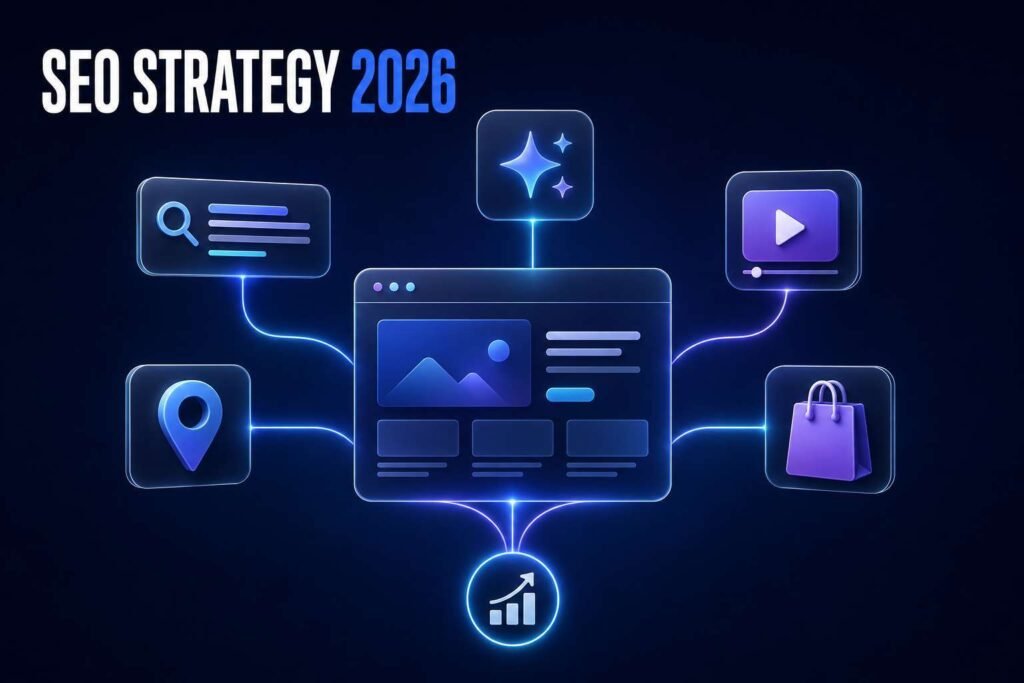
What has changed is the shape of discovery. A potential customer may see a standard result, a map listing, a product result, a video, or an AI generated answer before visiting a website. That makes ranking position only one part of search visibility. It also means broad informational traffic can be less valuable than a smaller audience arriving with a clear commercial need.
Avoid building a separate plan around every new industry label. Google states that special AI markup, forced content chunking, and rewriting pages solely for generative systems are not required for visibility in its generative features. Follow Google guidance for generative AI search, then invest in information that is original, accurate, accessible, and useful enough to be referenced.
1. Define the business outcome before choosing SEO work
Start with the result the business needs. More traffic is too vague. A useful objective identifies the audience, the action, the market, and the time frame.
For example, a software company may want more qualified demonstration requests from mid market operations teams. A local clinic may need appointment enquiries from three profitable treatment categories. An online retailer may want more nonbrand revenue from products with healthy stock and margins. Each objective creates a different organic growth strategy.
Translate the goal into a simple chain:
Business goal, audience need, search behaviour, landing page, conversion action, commercial value.
If the chain breaks, fix it before increasing output. Publishing more articles will not solve a weak offer, unavailable products, poor location coverage, or a contact form that nobody owns.
The Mahmud Jibon search engine optimisation service provides a useful internal destination for readers who need help with technical structure, content direction, and implementation. It also gives the article a natural commercial next step without interrupting the guidance.
Choose one primary outcome and supporting indicators
One primary outcome keeps the plan honest. It could be organic qualified leads, ecommerce gross profit, booked consultations, trial starts, or another action that the business can verify.
Supporting indicators diagnose progress. Impressions can show expanding visibility. Click through rate can reveal whether listings attract attention. Rankings can expose movement within priority topics. Engagement and assisted conversions can show whether early research content helps later decisions. None should replace the primary commercial outcome.
2. Establish an accurate baseline
A step by step guide to SEO strategy 2026 should begin with evidence, not a list of fashionable tactics. Record where performance stands before changing the site. Otherwise, the team may claim credit for seasonal demand or blame SEO for a tracking error.
Review at least the previous twelve months when data allows. Compare year on year patterns, brand and nonbrand demand, devices, countries, page groups, and conversion types. For a young site, use the longest reliable period available and label the limitations.
Google explains that Search Console measures activity before a person reaches the site, while Google Analytics measures behaviour after arrival. Their numbers will not match exactly because clicks and sessions are calculated differently. Use Google guidance on combining Search Console and Analytics data to interpret trends without forcing false agreement.
Your baseline should cover:
- Organic conversions and estimated commercial value
- Qualified lead rate or revenue by landing page group
- Nonbrand clicks and impressions for priority markets
- Indexed pages, excluded pages, and crawl issues
- Pages losing clicks, conversions, or search visibility
- Referring domains and credible brand mentions
- Publishing capacity, development capacity, and approval delays
Separate measurement faults from performance faults
A sudden conversion decline may come from a broken form event, a consent configuration change, or a migrated thank you page. Check the buying path manually before changing the SEO roadmap. Measurement repair may be the highest priority because every later decision depends on it.
3. Research demand, customers, and competitors
Keyword research should reveal demand, but search volume alone does not reveal value. Interview sales, support, product, and customer facing teams. Their language exposes objections, qualification questions, urgent problems, and reasons buyers choose another option.
Group searches by intent and decision stage. A question about how a service works needs a different page from a comparison, location search, product category, or request for a quote. Map related terms to one useful page when they share intent. Creating a separate page for every minor phrase variation produces overlap and weakens maintenance.
Use competitor analysis to find choices, not copy lists
Search competitors are not always commercial competitors. A marketplace, publisher, forum, government body, or video platform may occupy the result a business wants. Review the actual results for priority searches and note the formats, page types, evidence, freshness, and user needs being served.
Competitor analysis should answer four questions:
- Which valuable topics do they cover that you do not?
- Which pages earn links or references, and why?
- Where is their answer generic, outdated, or poorly matched to intent?
- Which opportunities suit your expertise and resources?
The last question prevents an expensive mistake. A small consultancy should not copy a global publisher’s daily production model. It may win through original frameworks, detailed case analysis, and expert answers in a narrower field.

4. Build an SEO strategy 2026 opportunity map
Turn research into a manageable set of opportunity areas. Most plans need a balance of technical foundations, existing page improvements, new demand coverage, conversion work, internal linking, and authority building. The balance depends on the constraint.
| Current constraint | Evidence | Suitable response | Poor response |
|---|---|---|---|
| Important pages are not indexed | Coverage and inspection data show discovery or indexing problems | Fix crawl paths, canonicals, rendering, and page quality | Publish more pages into the same broken structure |
| Pages rank but attract few clicks | Impressions are healthy, but click through rate is weak | Improve titles, descriptions, result eligibility, and intent match | Chase unrelated high volume keywords |
| Traffic arrives but does not convert | Landing pages attract relevant visits, but actions remain low | Strengthen proof, offer clarity, calls to action, and user experience | Report traffic growth as success |
| Commercial coverage is thin | Competitors serve valuable decision stage searches that the site ignores | Build service, comparison, category, use case, or location pages | Produce broad educational content only |
| Strong pages lack authority | Content is competitive, but credible references and links are limited | Create reference worthy assets and targeted digital PR | Buy bulk links or pursue irrelevant mentions |
This map makes SEO planning concrete. It also reveals when the correct project sits partly outside SEO, such as pricing clarity, stock availability, design, or sales follow up.
5. Prioritise work by value, confidence, effort, and dependency
A long audit is not a strategy. Prioritisation turns findings into decisions. Score each proposed project using four practical factors.
- Business value. How closely does the project support the primary outcome?
- Evidence and confidence. Is the problem visible in reliable data, customer feedback, or testing?
- Effort and delay. How much specialist time, approval, and development work does it require?
- Dependency. Does other work rely on this being completed first?
A tracking repair may have modest direct revenue value but high dependency. A new content hub may offer substantial upside but low confidence if the business has no authority in that subject. A service page refresh may be the best first move when it already receives qualified impressions and the sales team confirms demand.
SEO strategy 2026 best practices should also include a stop list. Pause content that serves no audience, reports nobody uses, and recurring tasks with no clear hypothesis. Capacity recovered from low value activity often funds the work that matters.
6. Turn priorities into a quarterly SEO roadmap
Annual direction helps with budget and coordination. Quarterly planning is better for SEO strategy 2026 execution because search results, product priorities, internal capacity, and evidence can change.
Limit each quarter to a few meaningful projects. Every project needs an owner, completion definition, dependency, expected signal, and review date. Avoid filling the SEO roadmap with dozens of tiny tasks that obscure the intended result.
A practical four quarter model
| Quarter | Main purpose | Example deliverables | Decision at review |
|---|---|---|---|
| First | Repair measurement and foundations | Analytics validation, indexation fixes, page templates, priority page refreshes | Is reliable growth now measurable? |
| Second | Expand valuable coverage | Commercial pages, topic clusters, internal links, supporting proof | Are priority queries and conversions moving? |
| Third | Strengthen authority and conversion | Research assets, outreach, case studies, landing page tests | Is visibility translating into qualified demand? |
| Fourth | Consolidate and plan | Content pruning, updates, forecast review, next year priorities | What should scale, change, or stop? |
Treat this as a planning pattern, not a universal sequence. A healthy established site may begin with commercial expansion. A site migration may require technical risk control before anything else. An ecommerce business approaching peak season should complete structural changes early enough for discovery, testing, and correction.

7. Plan the budget around the constraint
SEO strategy 2026 budget planning should reflect the work, not an arbitrary split between content and links. Include research, writing, editing, design, development, analytics, outreach, tools, and project management. Internal approval time also has a cost, even when it does not appear on an agency invoice.
A technically unstable site may need more development capacity early. A specialist business with a sound site may need expert interviews and editorial support. A local service company may benefit more from location pages, review operations, and business profile management than from a large national content programme.
Choose an ownership model that matches complexity. An internal lead is valuable when SEO touches product, sales, engineering, and brand teams. A specialist consultant can supply diagnosis and direction where the team can execute. An agency may suit a business that needs coordinated delivery across several disciplines. Before hiring, clarify who approves changes, who owns access, how knowledge is transferred, and what happens when recommendations compete with other priorities.
8. Execute content, technical, and authority work as one system
The best practices for SEO strategy 2026 are connected. A strong article cannot compensate for accidental noindex tags. Fast pages do not create demand when the offer is unclear. Backlinks rarely rescue content that does not answer the searcher’s problem.
Technical foundations for SEO strategy 2026
Confirm that priority pages can be discovered, rendered, indexed, and served consistently. Review internal links, canonicals, redirects, sitemaps, duplicate paths, mobile content, structured data eligibility, and performance. Google describes crawling, indexing, and serving as separate stages in its guide to how Search works, which is a useful model for diagnosis.
Use PageSpeed Insights for performance investigation, but do not reduce technical SEO to a single score. Real user experience, template stability, conversion paths, and the needs of the audience matter more than cosmetic scoring gains.
Content that contributes something specific
Create pages around genuine decisions and problems. Add first hand process knowledge, original examples, clear limitations, current sources, useful visuals, and accountable authorship. Generic summaries are easy to produce and easy to replace.
Update existing pages when they already have relevant impressions, links, or conversions. Create new pages when a meaningful intent is not covered. Consolidate pages when several weak URLs compete for the same need. The right choice comes from page level evidence, not a fixed publishing quota.
Link related pages so readers and crawlers can understand the subject structure. Readers who need broader web implementation context can review Mahmud Jibon’s portfolio projects and the latest articles and guides.
Authority that can withstand scrutiny
Earn attention by producing something worth referencing, such as original data, a practical tool, a precise guide, a case study with verifiable methods, or informed commentary. Outreach works better when the asset solves a real editorial need. Relevance and credibility matter more than raw link counts.
Avoid paid link schemes, automated placements, and manufactured endorsements. Google Search Essentials prohibits spam practices, and compliance should be checked against the current Google Search Essentials before publication or campaign launch.
9. How to measure results from SEO strategy 2026
Measurement should connect early indicators to business outcomes without pretending attribution is perfect. Review results by landing page group, intent, market, and conversion type. Sitewide totals can hide valuable growth in one area and decline in another.
Use three levels of reporting:
- Delivery measures, such as completed fixes, refreshed pages, and published assets
- Search measures, such as indexed priority pages, impressions, clicks, and visibility for valuable topics
- Business measures, such as qualified leads, sales, revenue, gross profit, and acquisition cost
Set expectations according to the project. A corrected tracking event can be verified quickly. Reprocessing technical changes may take time. New content and authority work often need a longer observation period, especially in competitive markets. Do not promise a universal result date.

Run a disciplined monthly and quarterly review
Monthly reviews should spot tracking faults, technical incidents, unusual losses, and delivery blockers. Quarterly reviews should ask larger questions. Did the constraint move? Which project created a credible signal? Which assumptions failed? Should the next quarter scale, revise, or stop the work?
Record major site changes, campaigns, product launches, seasonality, and known search updates beside performance data. This prevents teams from inventing simple explanations for complex movement.
Common mistakes that weaken SEO planning
The first SEO strategy 2026 mistake is starting with a fixed content volume. Ten articles per month may be sensible for a publisher and wasteful for a business whose priority service pages cannot convert.
The second is treating every audit issue as equally urgent. A missing description on an unimportant page should not outrank a broken canonical on a revenue page.
Another common error is measuring only traffic. Informational visits can grow while qualified demand falls. Segment performance and connect priority landing pages to actions that sales or ecommerce systems can confirm.
Finally, do not rebuild the plan after every fluctuation. Investigate material changes, but give completed projects enough time to produce usable evidence. SEO strategy 2026 requires adaptability, not constant reaction.
Final Thoughts
A useful SEO strategy 2026 plan does not attempt every tactic. It identifies the business outcome, finds the constraint, selects a small number of evidence based projects, and measures whether those projects improve qualified demand.
Build the first roadmap around the clearest bottleneck. Repair measurement and technical dependencies early. Invest in content and authority where the business has something credible to contribute. Review the direction quarterly, then scale only what produces a defensible signal.
Request an SEO strategy consultation
Need a clear plan for your website, market, and resources? Request an SEO strategy consultation with Mahmud Jibon to turn your current search data, business priorities, and delivery capacity into a focused SEO roadmap.
Frequently asked questions
What should an SEO strategy 2026 include?
It should include a defined business outcome, performance baseline, customer and competitor research, technical priorities, content opportunities, authority work, budget, ownership, an SEO roadmap, and a measurement plan. The mix should reflect the site’s main constraint rather than a standard checklist.
How often should an SEO strategy 2026 plan be reviewed?
Monitor delivery and serious performance issues monthly. Review strategic priorities quarterly. Annual planning remains useful for budgets and larger dependencies, but it should not prevent changes when evidence or business priorities shift.
How much content should a business publish?
There is no universal number. Publish at the rate that research, expertise, editing, design, and promotion can support. Improving a page with existing demand may create more value than adding a new article, while a new site with clear coverage gaps may need consistent creation.
How long does SEO take to produce business results?
The timing depends on the site’s condition, competition, demand, authority, and type of work. Tracking repairs can be confirmed quickly, while new content and reputation building may take considerably longer. Set project specific leading indicators and avoid guaranteed timelines.
Is AI search optimisation separate from SEO?
Not entirely. Google advises that established SEO foundations remain relevant to its generative search features. Clear, crawlable, original, and reliable content is a better investment than unsupported AI specific tricks. Other discovery platforms may provide different guidance, so verify their current documentation before publication.
What is the first step for a limited budget?
Confirm measurement, identify the pages and searches closest to revenue, and address the clearest constraint. A focused improvement to existing commercial pages is often more manageable than a broad publishing programme, but technical access problems must be fixed first when they block indexation.