

Choosing where to invest your marketing budget is one of the biggest decisions a growing business faces. Search visibility can bring a steady stream of potential customers, but the path you choose matters. Many businesses struggle with the same question: should they focus on SEO or spend money on paid advertising?
The SEO vs PPC decision is not simply about choosing the cheaper option. Both channels work differently, require different levels of commitment, and deliver value at different stages of business growth.
SEO focuses on building organic visibility through website improvements, useful content, technical optimisation, and authority building. PPC focuses on paying for targeted visibility through platforms such as Google Ads, where businesses can appear in front of potential customers almost immediately.
For a business with limited resources, choosing the wrong channel can waste months of effort or drain advertising budgets without creating sustainable growth.
This guide explains the SEO vs PPC comparison in practical terms. You will learn how organic search cost differs from paid search cost, how to compare SEO and paid search returns, and when investing in organic search or paid advertising makes the most sense for your business.
What Is SEO and What Is PPC?
Before deciding between SEO and PPC, it helps to understand how each channel works.
What Is SEO?
Search engine optimization, commonly known as SEO, is the process of improving a website so it can appear higher in organic search results.
When someone searches for a product, service, or solution, Google evaluates thousands of signals to determine which pages provide the most relevant and trustworthy answers. SEO helps businesses improve those signals.
A complete SEO strategy usually includes:
- Technical website improvements
- Keyword research
- Content creation
- Internal linking
- Website speed optimisation
- User experience improvements
- Competitor analysis
- Building authority through relevant mentions and links
The goal of SEO is not simply to rank for more keywords. The goal is to attract the right visitors who are more likely to become customers.
For example, a roofing company does not just want visitors searching general roofing information. It wants homeowners searching terms such as “roof replacement contractor” or “roof repair near me.”
A strong SEO roadmap helps businesses identify these opportunities and create content and pages that match customer intent.
You can review Google’s official guidance on creating helpful content through Google Search Central:
https://developers.google.com/search/docs/fundamentals/creating-helpful-content
What Is PPC?
Pay per click advertising, or PPC, is a form of digital advertising where businesses pay when someone clicks their advertisement.
Google Ads is one of the most common PPC platforms. Businesses can bid on keywords and display ads when users search for related terms.
For example, a company selling accounting services can create an advertisement that appears when someone searches “small business accountant.”
The advantages of PPC are speed and control. Businesses can choose:
- Which keywords to target
- How much they want to spend
- Which locations to advertise in
- Which audience segments to reach
However, PPC traffic depends on continuous investment. Once advertising stops, the visibility usually disappears.
Google provides official information about how search advertising works through Google Ads:
https://ads.google.com/home/

SEO vs PPC: Understanding the Core Differences
The biggest difference between SEO and PPC is how visibility is earned.
SEO requires businesses to build credibility and relevance over time. PPC allows businesses to purchase immediate placement in search results.
Neither approach is automatically better. The right choice depends on business goals, competition, available budget, and expected timeline.
| Factor | SEO | PPC |
| Traffic source | Organic search results | Paid advertisements |
| Speed | Usually takes time to build results | Can generate traffic quickly |
| Payment model | Investment in strategy and optimisation | Pay for clicks or conversions |
| Long term value | Can continue generating traffic after ranking improves | Stops when budget stops |
| Control | Less direct control over rankings | More control over targeting |
| Best use | Sustainable growth | Immediate visibility and testing |
A new business launching a service may need PPC to generate early leads. An established business looking to reduce advertising dependency may prioritise SEO.
Many successful companies eventually use both because each channel supports a different part of the customer journey.
SEO vs PPC Comparison: Cost, Speed, and Long Term Value
When businesses compare SEO and PPC, cost is usually the first concern. However, the cheapest option upfront is not always the most profitable option.
Understanding Organic Search Cost
Organic search cost includes the investment required to improve a website and create valuable content.
This may include:
- SEO strategy development
- Content production
- Technical fixes
- Website improvements
- Research and analysis
- Ongoing optimisation
The challenge with SEO is that results are not immediate. A business may invest months before seeing significant improvements in rankings and traffic.
However, successful SEO campaigns can create lasting value. A well optimised service page or article may continue attracting visitors for years with ongoing maintenance.
For example, a software company that creates a detailed guide answering customer questions may continue receiving organic visitors long after publication.
Understanding Paid Search Cost
Paid search cost is easier to calculate because businesses directly control their advertising budget.
A company can spend a specific amount per day and measure:
- Clicks received
- Leads generated
- Sales created
- Customer acquisition cost
The downside is that PPC requires continuous spending. If competitors increase their bids or advertising costs rise, maintaining visibility may become more expensive.
For businesses in highly competitive industries such as insurance, legal services, or finance, PPC costs can become significant.

How to Compare SEO and Paid Search Returns
A common mistake businesses make is comparing SEO and PPC only by traffic numbers.
Traffic alone does not determine success.
A better comparison looks at business outcomes:
Customer Acquisition Cost
How much does it cost to gain one customer?
PPC provides clear numbers because advertising platforms show spending and conversions.
SEO requires more detailed measurement because costs are spread across content, strategy, and technical improvements.
Conversion Quality
Not all visitors have equal value.
A website receiving 10,000 visitors from unrelated searches may generate fewer customers than a website receiving 1,000 visitors from highly targeted searches.
The important question is not:
“How much traffic did we get?”
It is:
“How many valuable customers did this traffic create?”
Long Term Return
PPC often performs well when immediate results matter. For example, an ecommerce store promoting a seasonal sale may benefit from paid campaigns.
SEO often becomes more valuable over time because rankings can continue producing traffic without paying for every visitor.
The best channel depends on how quickly you need results and how much long term growth matters to your business.
When Should a Growing Business Invest in SEO?
SEO is usually the stronger choice when a business wants to build a reliable source of traffic that does not depend entirely on advertising spend.
However, SEO works best when businesses understand that it is a long term investment. It requires consistent improvement, regular content development, and patience. A company that invests in SEO today may not see major results immediately, but the foundation created can continue producing value over time.
SEO investment options are especially suitable for businesses that:
- Want consistent visibility in search results
- Operate in industries where customers research before buying
- Have valuable expertise that can be turned into helpful content
- Want to reduce dependence on paid advertising
- Need a stronger online presence compared with competitors
For example, imagine two accounting firms competing in the same city.
One company relies only on PPC ads. Every month, it pays to appear when someone searches for accounting services.
The second company invests in SEO by creating useful pages about tax planning, bookkeeping, business accounting, and financial questions. Over time, those pages begin attracting visitors from different searches.
The second company may still use PPC, but it is building an additional source of leads that does not disappear when advertising stops.
Businesses That Often Benefit From SEO
Local Service Businesses
Companies such as plumbers, roofers, dentists, law firms, and consultants can benefit significantly from SEO because customers often search locally before contacting a provider.
A strong local SEO strategy can improve visibility for searches related to services, locations, and customer problems.
Businesses With High Customer Value
When one customer is worth hundreds or thousands of dollars, investing in long term search visibility can make financial sense.
A professional service company may find that ranking for valuable keywords creates consistent enquiries over time.
Businesses With Educational Value
Some industries naturally create opportunities for content.
Software companies, healthcare providers, financial experts, and B2B companies can answer customer questions through articles, guides, and resources.
This creates opportunities to attract users earlier in the buying journey.

When Is PPC the Better Choice?
Although SEO provides long term benefits, there are situations where PPC is the more practical option.
PPC is valuable when a business needs immediate visibility and cannot wait months to build organic rankings.
New Businesses Testing Market Demand
A new company may not know which keywords, offers, or messages attract customers.
PPC allows businesses to test different approaches quickly.
For example, an online store launching a new product can advertise several variations and identify which keywords produce sales before investing heavily in SEO content.
Time Sensitive Promotions
Businesses running limited offers, events, or seasonal campaigns often benefit from PPC because campaigns can be launched quickly.
Examples include:
- Holiday promotions
- Event registrations
- New product launches
- Limited availability services
SEO is still valuable, but it may not deliver fast enough for short campaigns.
Highly Competitive Search Results
Some industries have extremely competitive organic rankings.
A small business competing against large brands may struggle to reach the first page quickly.
PPC can provide immediate visibility while the company builds its SEO foundation.
However, businesses should avoid becoming completely dependent on paid advertising. Rising costs, competition, and changing customer behaviour can make PPC less predictable over time.
Should Businesses Use SEO and PPC Together?
The SEO vs PPC discussion often creates the impression that businesses must choose only one option.
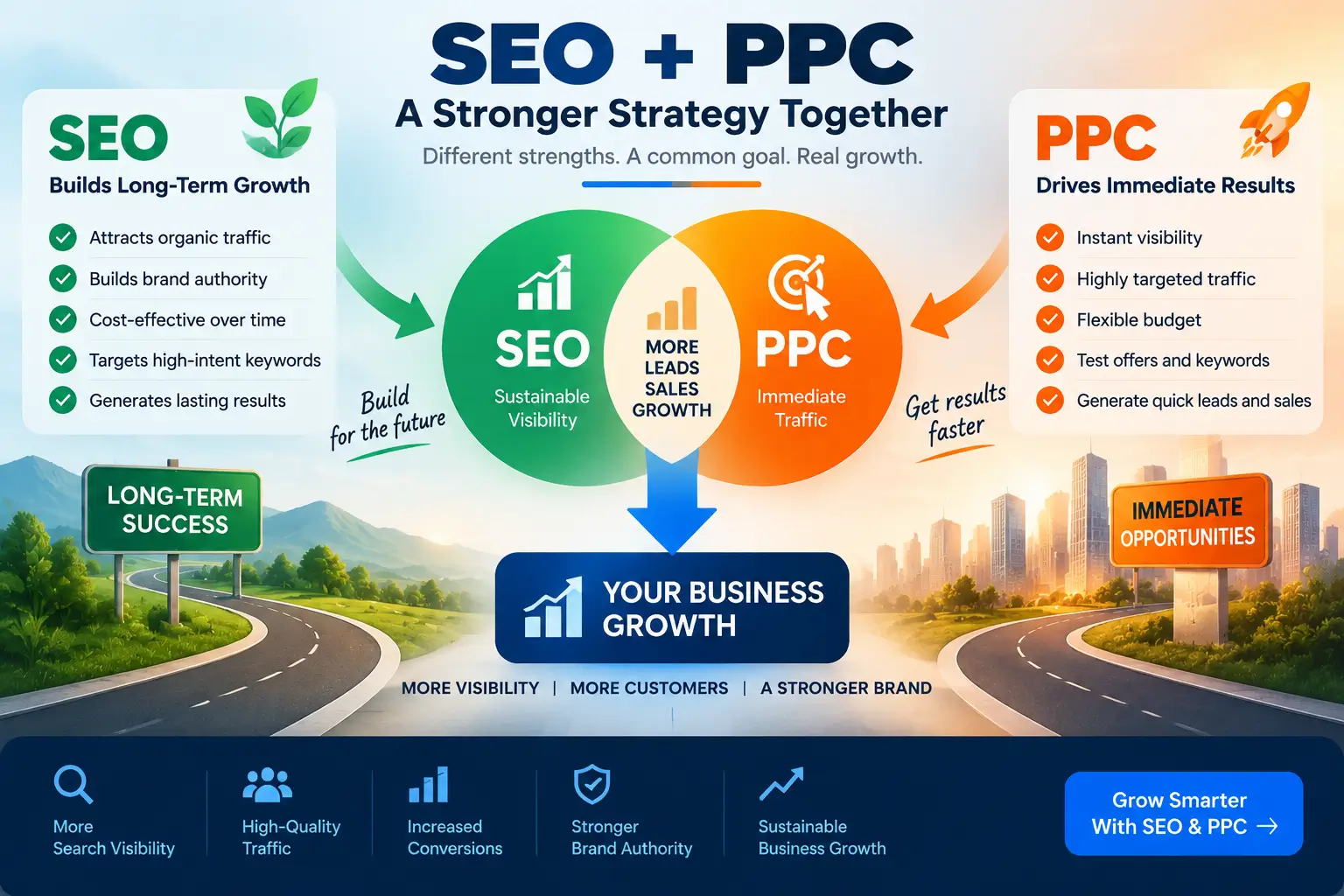
In reality, many growing businesses benefit from using both channels together.
SEO and PPC can support each other when managed correctly.
How PPC Supports SEO
Paid campaigns can provide valuable information about:
- Which keywords attract customers
- Which landing pages convert best
- Which messages create engagement
This information can help shape future SEO content and website improvements.
For example, if a PPC campaign shows that a specific keyword generates qualified leads, a business may decide to create a dedicated SEO page targeting that same search intent.
How SEO Supports PPC
SEO improvements often improve website quality overall.
Better content, clearer navigation, faster pages, and stronger user experience can help paid visitors convert more effectively.
A business that sends PPC traffic to a poorly designed website may waste advertising budget.
A website built with SEO principles usually provides a better experience for all visitors.
Common Mistakes Businesses Make With Search Marketing
Choosing the wrong strategy is not the only problem. Many businesses lose money because they approach SEO or PPC without proper planning.
Expecting Instant SEO Results
SEO is often misunderstood because businesses see competitors ranking and assume they can achieve similar results quickly.
The reality is that rankings depend on many factors, including website quality, competition, content depth, and authority.
A proper SEO roadmap focuses on steady improvement rather than quick shortcuts.
Running PPC Without Conversion Tracking
Driving visitors to a website is only useful if you understand what happens afterward.
Businesses should track important actions such as:
- Contact form submissions
- Phone calls
- Purchases
- Appointment bookings
- Newsletter signups
Without measurement, it becomes difficult to know whether paid search cost is producing profitable results.
Google Analytics provides official resources for measuring website performance:
https://support.google.com/analytics/
Ignoring Competitor Analysis
Some businesses create SEO content without understanding what already exists.
Competitor analysis helps identify:
- Which topics competitors rank for
- Which keywords create opportunities
- Where content gaps exist
- How competitors position their services
Good marketing decisions come from understanding the market, not simply publishing more pages.
Choosing Keywords Based Only on Search Volume
A keyword with thousands of searches is not always valuable.
A smaller keyword with strong buying intent may generate more customers.
For example:
“best accounting software”
may attract researchers, while:
“accounting software for construction companies”
may attract a more specific audience closer to purchasing.
Search intent matters more than traffic volume alone.
How to Choose the Right Search Strategy for Your Business
There is no universal answer to which channel every business should choose.
The right decision depends on your situation.
Consider these questions:
How Quickly Do You Need Results?
If you need leads immediately, PPC may be the practical starting point.
If you are building a long term marketing asset, SEO deserves attention.
What Is Your Competition Like?
A competitive market may require both strategies.
PPC can create visibility while SEO builds authority over time.
What Is Your Budget?
Businesses with limited budgets should focus on efficiency.
Spending heavily on PPC without understanding conversion rates can become expensive.
Investing in SEO without realistic expectations can also create frustration.
What Are Your Business Goals?
Different goals require different approaches.
| Business Goal | Recommended Approach |
| Generate leads quickly | PPC |
| Build long term visibility | SEO |
| Test new services | PPC |
| Reduce advertising dependency | SEO |
| Capture immediate and future demand | SEO + PPC |
A smart strategy is based on priorities, not trends.
Building a Practical SEO and PPC Roadmap
For many growing businesses, the most effective approach is gradual.
A practical roadmap may look like this:
Stage One: Establish Visibility
Start with foundational improvements:
- Fix technical SEO issues
- Improve important service pages
- Set up conversion tracking
- Research competitors
- Identify valuable keywords
Stage Two: Generate Immediate Demand
Use PPC campaigns where quick visibility is needed.
Test:
- Keywords
- Offers
- Landing pages
- Customer messaging
Stage Three: Scale Organic Growth
Use PPC insights to guide SEO investment.
Create content around proven customer searches and continue improving website authority.
This approach allows businesses to collect data while building sustainable growth.

Final Thought
The SEO vs PPC decision should be based on your business goals, timeline, competition, and available resources.
PPC is valuable when you need immediate visibility, want to test demand, or promote a time sensitive offer.
SEO is valuable when you want to build sustainable search visibility and create a long term source of organic traffic.
For many growing businesses, the strongest approach is not choosing one and ignoring the other. A balanced strategy uses PPC for immediate opportunities while building SEO foundations that create future growth.
The right investment is the one that matches where your business is today and where you want it to be tomorrow.
Request an SEO strategy consultation with Mahmud Jibon to identify the right search growth plan for your business.
Frequently Asked Questions
Is SEO better than PPC for a small business?
It depends on the business goals. Small businesses needing immediate leads may benefit from PPC, while those building long term visibility may find SEO more valuable.
How long does SEO take compared with PPC?
PPC can start generating traffic shortly after campaigns launch. SEO usually requires several months of consistent work before significant results appear.
Is organic search cheaper than paid advertising?
Not always. SEO requires investment in strategy, content, and technical improvements. However, successful SEO can continue generating traffic without paying for each visitor.
Can SEO and PPC be used together?
Yes. Many businesses combine both channels. PPC provides immediate visibility, while SEO builds long term organic growth.
How do I know which channel is working?
Measure business outcomes such as leads, sales, conversion rates, and customer acquisition cost rather than traffic alone.